What is Foucault's theory of power and knowledge?
 David Richardson
 What is Foucault's definition of knowledge?
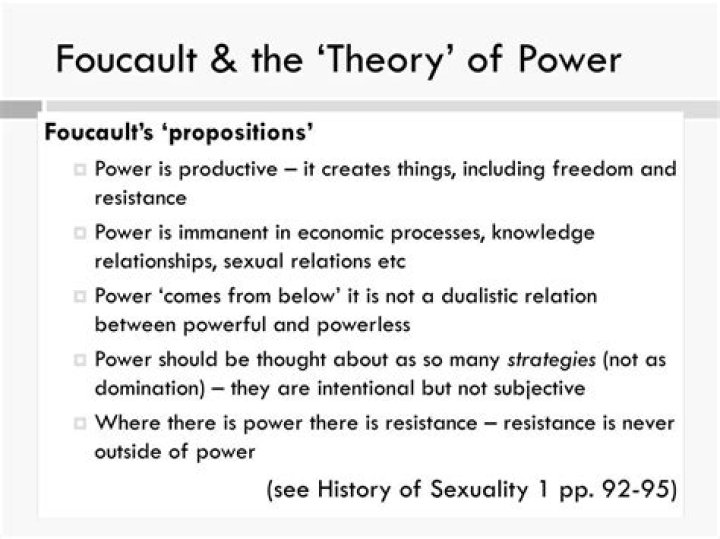
According to Foucault, all knowledge is possible and takes place only within a vast network or system of power relationships that allow that knowledge to come to be, in order for statements accepted as “true” in any context to be uttered, and in order for what counts as knowledge to be generated in the first place.
What was Foucault's theory?
In his 1975 book Discipline and Punish, Foucault argued that French society had reconfigured punishment through the new “humane” practices of “discipline” and “surveillance”, used in new institutions such as prisons, the mental asylums, schools, workhouses and factories.
How does power produce knowledge Foucault?
According to Foucault's understanding, power is based on knowledge and makes use of knowledge; on the other hand, power reproduces knowledge by shaping it in accordance with its anonymous intentions. Power (re-) creates its own fields of exercise through knowledge.
What are the two main types of power according to Foucault?
As modes of power in democracies, Foucault explicitly identified:
- Sovereign power.
- Disciplinary power.
- Pastoral power.
- Bio-power.
Foucault Power and Knowledge
What is the meaning of knowledge is power?
The phrase 'Knowledge is Power'signifies that the true power, a man can withhold is the knowledge that he has obtained. Physical power has its own limitations but knowledge will let you do great things that have never been thought of before.
What was Foucault's best known for?
Michel Foucault began to attract wide notice as one of the most original and controversial thinkers of his day with the appearance of The Order of Things in 1966. His best-known works included Discipline and Punish: The Birth of the Prison (1975) and The History of Sexuality, a multivolume history of Western sexuality.
What is power theory?
Power Basis Theory argues that the ontological necessity of power arises from the requirements humans have for survival (their basic needs). Power motivations are what encourage action to meet those needs and are prompted by the psychological apparatus humans have for detecting those needs (sensibilities).
What are Foucault's views on discourse and power explain?
Discourse, as defined by Foucault, refers to: ways of constituting knowledge, together with the social practices, forms of subjectivity and power relations which inhere in such knowledges and relations between them. Discourses are more than ways of thinking and producing meaning.
What is the relationship between power and knowledge?
Knowledge is not independent of the individuals who hold it ; it is a product of power relationships. According to Lubit (2001), knowledge is the base of power and respect ; what often lead people to hesitate to share knowledge because they fear a decrease of their power.
What are the 4 types of power?
Questioning Four Types of Power
- Expert: power derived from knowledge or skill.
- Referent: power derived from a sense of identification others feel toward you.
- Reward: power derived from an ability to reward others.
- Coercive: power derived from fear of punishment by others.
What are the different theories of power?
The main rivals to the Four Network theory: pluralism, state autonomy theory, elite theory, and Marxism.
Who developed power theory?
In “The Concept of Power” (1957), his first major contribution to the field of political science, Dahl developed a formal definition of power that was frequently cited as an important (though incomplete) insight into the phenomenon. According to Dahl, “A has power over B to the…
What is a statement for Foucault?
According to Foucault, a 'discourse' is a group of statements which is different from other groups of statements. A 'statement' is a linguistic unit which is different from a sentence, proposition, or act of speech. A statement is any series of signs which may appear in an enunciative field.
What is Foucault's theory of disciplinary power?
Foucault's disciplinary power is a mechanism of power that does not use force or coercion to obtain compliance, but instead relies on everyday institutions and interactions to allow individuals to govern their own behaviour.
What is Foucault's view on human nature?
According to him, our conceptions of human nature are acquired from our own society, civilization and culture. He gave, as an example of this, late 19th and early 20th century Marxism which, according to Foucault, borrowed its conception of happiness from bourgeois society.
What's an example of knowledge is power?
For example, when we have knowledge on self-defense, although something physical, we instantly have power over those with the intention to harm us. The idea of using one's own knowledge for encouraging the goodness in society to thrive, has not gone unnoticed.
What is more important knowledge or power?
"A little knowledge is a dangerous thing."
Does knowledge lead to power?
Knowledge is not the power. Power is power. The ability to act on knowledge is power. Most people in most organizations do not have the ability to act on the knowledge they possess.
What are the 3 theories of power?
In this lesson, we explore societal and political power by looking at three differing power models: the pluralist model, the power-elite model, and the Marxist model. These models will be differentiated by the source and the nature of the power according to each model.
What is power and types of power?
Lesson Summary. As you can see, there are many different types of personal power. Personal power is the ability to control the environment around you. This can be accomplished through the five different types of power: reward power, coercive power, legitimate power, expert power, and referent power.
What are the characteristics of power?
There are 6 superpower characteristics! (Economic, Political, Military, Cultural, Demographic, Natural Resources), used to define which type of power a country is. Large GDP, high % of international trade, currency used as reserve currency.
What are the 3 nature of power?
Coercion, authority and influence are the three main forms of power. Each of these three forms of power emanates from different sources.
What are the 5 bases of power?
In 1959, social psychologists John French and Bertram Raven identified five bases of power:
- Legitimate.
- Reward.
- Expert.
- Referent.
- Coercive.